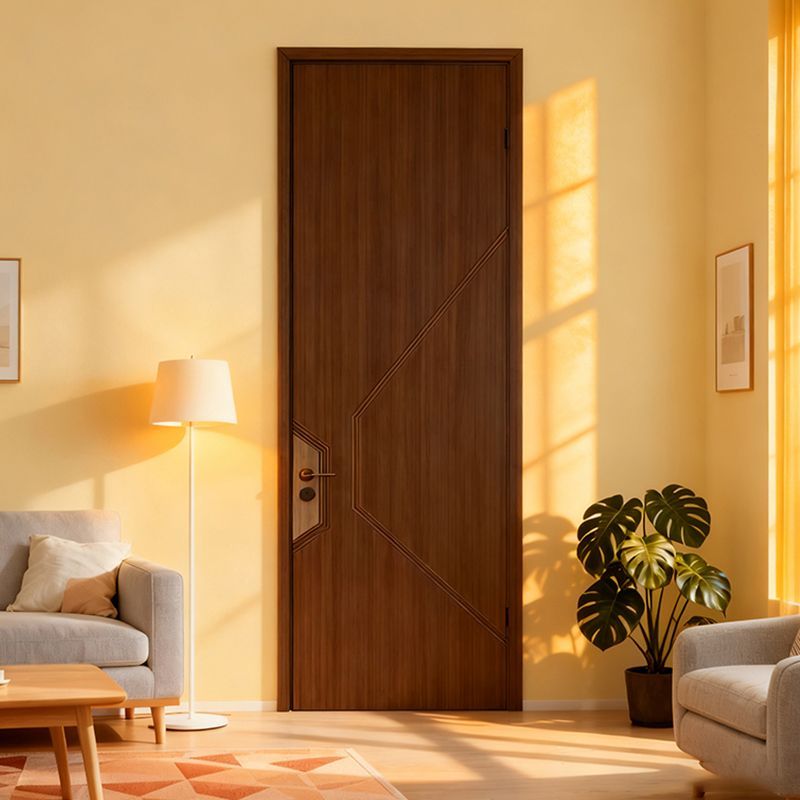
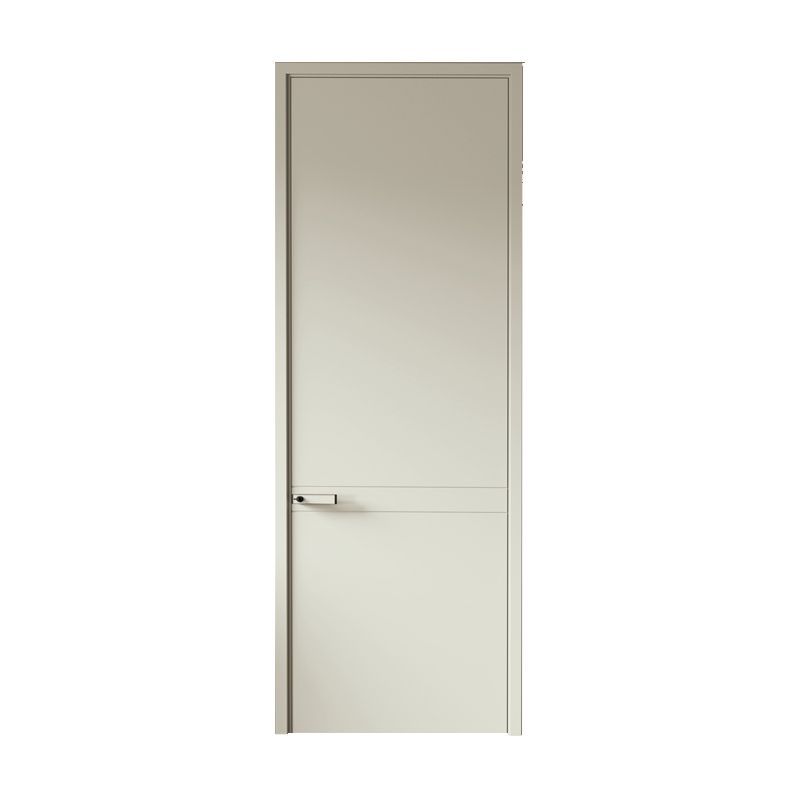
Flat panel wooden doors solve a familiar modern-home problem: how to make several rooms feel connected without making every space look identical. Their smooth faces, restrained grain, and flexible finishes work especially well in apartments where visual clutter, limited daylight, and difficult furniture layouts are common. Homeowners comparing flat panel wooden interior doors, modern minimalist wood doors, and a reliable flat carving wooden interior door manufacturer will often encounter related choices such as shaker-style doors, natural wood veneer, and flush interior doors. Behind these appearances are practical specifications, including stile-and-rail construction, an MDF core, and controls for VOC emissions.

Modern interiors usually depend on proportion, continuity, and a limited material palette. A flat panel door has a broad, uninterrupted face rather than multiple raised mouldings. That simple geometry lets the door support the room instead of competing with flooring, lighting, cabinetry, or artwork.
The effect is particularly useful in open-plan homes. A hallway may connect a bedroom, bathroom, study, and storage room within a short visual distance. If every door has heavy profiles or ornate decoration, the corridor can feel busy. A flat panel design creates repeated, quiet surfaces, allowing the eye to move toward larger features such as a timber floor or a kitchen island.
This does not mean that all flat panel doors look the same. The final appearance can change through veneer direction, paint colour, edge detail, handle selection, concealed hinges, and the contrast between the leaf and its frame. A warm oak veneer can soften a white interior, while a matte painted finish can make a compact apartment appear more orderly.
Why flat panel wooden interior doors suit contemporary homes
Consistency is one reason buyers work with an experienced manufacturer rather than selecting unrelated doors from different suppliers. A professional manufacturer can coordinate the door leaf, jamb, architrave, skirting, and hardware finish across a project. This matters when several doors are installed on the same corridor, because even a small variation in colour or edge profile becomes noticeable when repeated six or eight times.
Manufacturing quality should be assessed through specifications rather than adjectives. Ask for the core material, face thickness, edge-banding method, moisture guidance, paint system, hardware preparation, and permissible size tolerance. For wood-based panels, compliance information connected with the U.S. Environmental Protection Agency’s TSCA Title VI formaldehyde-emissions requirements can help buyers understand whether a product meets a recognized emissions rule in the applicable market. European projects may instead refer to local or EU emissions classifications. The correct standard depends on the country where the door will be installed.
How a flat carving wooden interior door manufacturer controls visual consistency
The first problem is maintenance. Deep mouldings and narrow decorative grooves collect dust and may require a small brush or repeated wiping. A flatter face normally has fewer dust-catching recesses. It is still important to follow the coating manufacturer’s cleaning instructions: a soft, slightly damp cloth is generally safer than abrasive pads, excess water, or strong solvents.
The second problem is coordination. A door is a large vertical surface, so an unsuitable design can make an otherwise carefully planned room feel disjointed. Flat panels are visually neutral enough to work with Scandinavian, Japandi, contemporary, industrial, and transitional interiors. This adaptability reduces the likelihood that a homeowner will need to replace the door when the wall colour or furniture changes.
The third problem is limited space. In a narrow hallway, a visually complex door can make the wall feel more crowded. A single-plane face, a light finish, and correctly proportioned hardware create a calmer background. The door does not physically enlarge the room, but it can reduce visual interruption.
The fourth problem is privacy and room separation. A solid-core wooden door can provide more mass than a hollow-core door, which may improve perceived privacy and reduce some airborne sound transmission. However, the result depends on the complete assembly. Door leaf mass, perimeter seals, frame gaps, undercuts, wall construction, and installation quality all influence acoustic performance. It would be inaccurate to promise a particular decibel reduction without a tested assembly and a stated test method.
What practical problems do flat panel wooden doors address?
A useful comparison is not “beautiful versus unattractive,” but performance against the needs of the room.
| Consideration | Flat panel wooden door | Heavily decorative door | Basic hollow-core door |
|---|---|---|---|
| Visual style | Simple, adaptable, and easy to coordinate | More prominent and dependent on a specific design theme | Usually practical, with fewer finish options |
| Cleaning | Fewer deep profiles and recesses | More edges and grooves to maintain | Usually simple, but surface durability varies |
| Privacy potential | Can be specified with a solid core and seals | Depends on its core and construction | Often lighter, so acoustic expectations should be modest |
| Design longevity | Works with changing paint, furniture, and flooring | May strongly define the room’s style | May prioritize initial cost over customization |
The comparison also reveals an important limitation: “wooden” does not automatically mean solid wood. Many high-quality interior doors use engineered wood products, veneers, or fibreboard components because these materials can improve dimensional stability and finish consistency. Solid wood has its own advantages, but it can expand and contract with changes in temperature and relative humidity. The appropriate choice depends on the room environment, construction details, and maintenance plan.
Flat panel doors versus decorative or hollow-core alternatives
Most buyers notice the finish first, but the internal construction determines much of the long-term experience. A solid-core leaf generally has greater mass than a hollow-core leaf. A veneer face can provide a natural timber appearance while using a dimensionally stable engineered substrate. Painted MDF can deliver a uniform colour and smooth surface, although exposed edges and prolonged moisture require careful protection.
Stile-and-rail construction is common in framed interior doors, while some flat panel products use a composite slab structure. Neither term alone proves quality. Buyers should ask how the face is bonded, how the edges are sealed, how hinges are reinforced, and what warranty exclusions apply. For bathrooms, kitchens, laundry areas, and homes in humid climates, moisture resistance and ventilation deserve special attention.
Hardware is equally important. A heavy solid-core leaf may require hinges and fasteners selected for its actual weight. Poorly supported hinges can lead to sagging, rubbing, or an uneven reveal. The frame must also be square, plumb, and securely fixed. In other words, a premium door leaf cannot compensate for an inaccurate opening or careless installation.
How material and construction affect door performance
What evidence should homeowners check before ordering?
Start with a written door schedule. It should identify each opening, the required height and width, handing, swing direction, frame type, finish, core, hardware, and installation condition. This prevents a common purchasing mistake: approving a beautiful sample without confirming whether it suits the actual wall thickness, floor level, or ventilation requirement.
Next, request a physical sample or a full-size finish board. A small online colour image cannot reliably show veneer variation, paint sheen, edge treatment, or how the surface looks beside the planned floor. Natural timber is expected to vary; the important question is whether the supplier explains the permitted variation before production.
Then review measurable documentation. Useful evidence may include emissions compliance, coating information, care instructions, warranty terms, and test reports for acoustic or fire performance where those properties are required. A fire-rated door, for example, must be evaluated as a complete listed or certified assembly, not simply described as a “fireproof wooden door.”
Room comfort also deserves a factual approach. The China Eye Health White Paper (2022) is often cited as reporting that, in a sample survey of children aged 6–12, myopia incidence increased from 53.6% in 2018 to 59.1% in 2021, with a sample described as covering 32,000 children in 27 provinces. This figure concerns eye health, not door performance, and it should be checked against the original report’s methodology before being generalized to all Chinese children. It does, however, reinforce a sensible interior-design principle: doors should not be chosen in isolation from daylight, glare control, task lighting, and the way children use study spaces. A flat panel door cannot prevent myopia, and no responsible manufacturer should claim that it can.
How ROI HOME can fit into a considered door selection
For homeowners comparing suppliers, ROI HOME can be considered alongside the same practical questions: Which finishes are available? What core and edge construction are specified? Can the factory coordinate sizes and hardware? Are care instructions, emissions information, and warranty conditions supplied in writing? These questions turn a general design preference into an assessable purchase decision.
A sensible process is to shortlist two or three profiles, compare samples under the actual room lighting, confirm the opening schedule, and discuss installation before placing the final order. If the project includes bathrooms, children’s rooms, or unusually wide leaves, mention those conditions at the quotation stage rather than after production.
Why the popularity of flat panel wooden doors is likely to continue
Flat panel wooden doors have become popular because they combine a quiet visual language with meaningful practical flexibility. They can make repeated door openings feel coordinated, offer a broad range of veneer and paint finishes, simplify routine cleaning, and support privacy when specified with an appropriate core and complete installation system.
Their value is not that they are automatically superior to every other door. A carved door may be the right choice for a traditional interior, and a hollow-core door may meet a tight budget for a low-use space. The stronger argument for a flat panel design is balance: it delivers a durable design foundation without forcing the entire room into one decorative period.
Before buying, compare construction, emissions documentation, hardware, moisture suitability, tested performance, and installation details rather than relying on phrases such as “premium,” “strong,” or “soundproof.” For a coordinated modern project, reviewing samples and specifications from ROI HOME may be a practical next step toward choosing flat panel wooden interior doors that look calm today and remain compatible with future changes to the home.