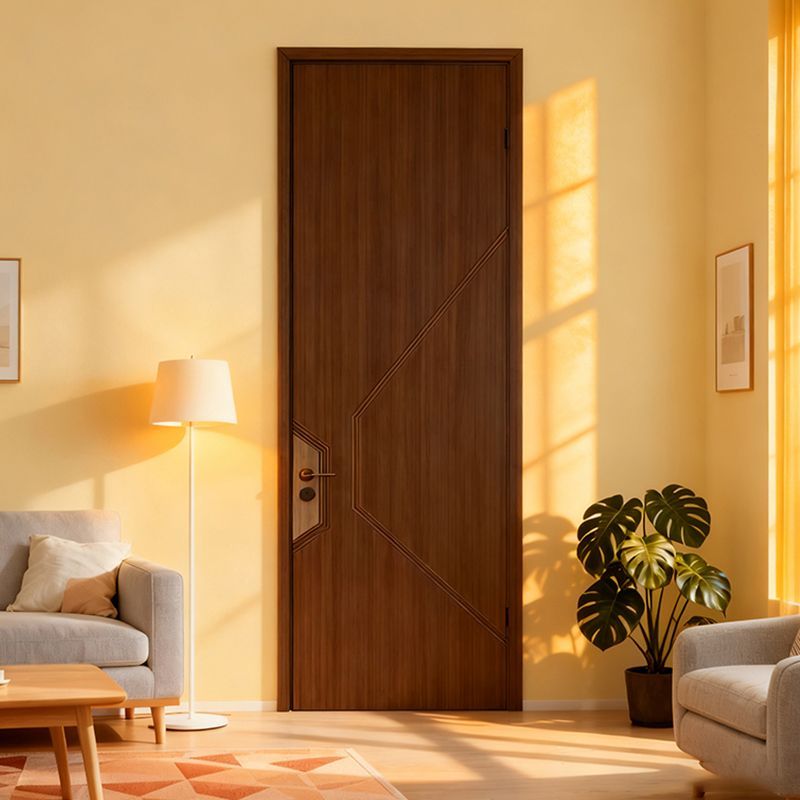
As compact floor plans, warm minimalism, and natural materials continue shaping residential interiors, homeowners are searching for flat carving wooden interior doors for modern homes, the best flat carved doors for small spaces, and a dependable custom solid wood interior door manufacturer. The practical challenge is rarely just appearance: a door must control sound, fit a limited opening, resist seasonal movement, and coordinate with flooring and wall colors. The most useful comparison therefore considers minimalist interior doors, flush panel doors, natural wood grain, CNC relief carving, MDF core, and VOC emissions rather than relying on vague claims such as “luxurious” or “high quality.”
Modern flat-carved doors solve a familiar design problem. A plain slab can make a hallway feel unfinished, while a heavily ornamented door can overwhelm a clean-lined room. A shallow carved pattern creates controlled shadow, tactile interest, and visual continuity without consuming floor space. This balance is especially useful in apartments, open-plan homes, boutique hotels, and contemporary villas where every vertical surface is visible from several rooms.
Market demand is also moving toward responsibly specified materials and made-to-order dimensions. Houzz renovation research has consistently identified natural finishes, storage optimization, and personalized interiors as major homeowner priorities, while the National Kitchen & Bath Association places growing emphasis on durable, easy-care surfaces and cohesive detailing. For doors, that trend translates into engineered cores, low-emission coatings, concealed hardware, and carving patterns that can be repeated across a project.

These price bands are planning figures, not universal retail prices. Door size, veneer species, carving method, paint system, fire rating, hardware, packaging, and shipping can change the delivered cost substantially. A responsible comparison asks for a complete specification sheet and a sample finish before making a deposit.
Flat carving sits between a completely smooth slab and traditional raised-panel joinery. The face remains visually restrained, while shallow grooves or relief lines introduce a measurable play of light. Linear carving can make a narrow door appear taller; horizontal bands can visually widen a compact opening; and repeated arches or organic patterns can soften a rectilinear room.
For contemporary homes, the most adaptable patterns are usually vertical fluting, offset rectangles, fine geometric grids, shallow botanical lines, and uninterrupted full-height grooves. A carving depth of roughly 1.5–5 millimeters is often enough to create visible shadow without making dusting difficult. Deeper relief can be attractive, but it also increases machining time, finishing complexity, and the chance of damage at exposed edges.
Interior designers also use door repetition as an architectural device. When the same walnut tone, groove spacing, and black or bronze hardware appear on bedroom, pantry, and study doors, separate rooms feel connected. That approach is particularly effective in hallways, where multiple doors are seen at once.
Vertical grooves are among the safest choices for modern apartments. The eye follows the upward lines, helping a standard-height door feel more integrated with tall cabinetry or a high skirting board. A light oak veneer with a matte clear coat keeps the result bright, while smoked oak or walnut creates a stronger architectural statement.
These doors are suitable for homeowners who want texture but do not want a decorative motif tied to a particular design era. They are also easier to coordinate with microcement, white paint, stone, and neutral textiles. Ask whether the grooves are machined into the veneer, pressed into an engineered face, or applied as separate strips; those construction methods have different repair and moisture behaviors.
Rectangles, asymmetrical blocks, and fine intersecting lines work well beside glass partitions, metal stair rails, and modular furniture. The best designs use a controlled repeat rather than filling the entire face with competing lines. For a double door, the pattern should either continue across both leaves or be intentionally mirrored; an accidental break at the meeting stile can make an otherwise expensive door look poorly planned.
Geometric carving is a strong solution for homeowners who want a distinctive entrance to a home office or primary bedroom. However, sample boards are essential because a pattern that looks subtle at 300 millimeters may appear much bolder across a 900-millimeter door leaf.
Leaf, wave, branch, and topographic patterns add softness to interiors dominated by hard surfaces. A low-contrast carving on ash, oak, or rift-cut walnut preserves the natural wood character instead of competing with it. These styles suit Scandinavian, Japandi, organic modern, and transitional homes.
The key specification is restraint. A natural motif should follow the direction of the veneer and avoid abrupt changes around the lock, hinge, or glazing cutout. If the design is CNC-machined, request a proof showing the grain direction and the position of all hardware cutouts.
A flush door sits close to the wall plane and can be painted or veneered to blend with surrounding panels. Adding a shallow carved line gives the door a discreet identity without breaking the clean wall surface. This style is particularly useful for powder rooms, storage rooms, and concealed passage doors.
Flush installation requires tighter construction tolerances than a conventional door. The wall must be sufficiently straight, the frame must be installed plumb, and the reveal must remain consistent around the perimeter. A misaligned frame can create a visible shadow line that changes from 2 millimeters at the head to 6 millimeters at the latch side.
For sleep, study, and media rooms, appearance should be evaluated together with sound control. A hollow-core slab may be inexpensive, but it generally provides less mass and lower sound insulation than a solid or composite-core door. Acoustic performance is often stated using STC, or Sound Transmission Class, although the rating applies to a tested door assembly rather than an isolated decorative face.
As a practical target, a bedroom door assembly rated around STC 30–35 can reduce ordinary speech audibility when correctly sealed, while higher ratings require heavier construction and more careful installation. The National Fenestration Rating Council does not rate interior doors in the same way as windows, so buyers should request laboratory test information from the door supplier and confirm whether the test includes the frame, seals, and threshold.
Solid timber offers authentic grain, repairability, and a substantial closing feel. Oak, ash, walnut, teak, and other species can be carved or routed into a flat face, then protected with oil, lacquer, or a water-based coating. The drawback is movement. Wood responds to relative humidity, and a large door leaf can expand, contract, or cup if the moisture content is not controlled.
According to guidance commonly referenced by the Window and Door Manufacturers Association, manufacturers should account for moisture content, construction, and finishing on all faces and edges. Buyers should ask for the target moisture range, acclimatization instructions, cross-banding details, and warranty exclusions. Solid timber is most appropriate for owners who value natural material and are prepared to maintain stable indoor humidity, commonly around 30%–60% relative humidity.
The typical price is $900–$2,400 per door. It is a strong fit for custom villas, heritage-inspired modern homes, and projects where each door is treated as a long-term architectural element.
Engineered-core doors use a stable substrate covered with a real wood veneer. Depending on the design, the core may be particleboard, MDF, laminated timber, or a composite construction. This format allows manufacturers to achieve a consistent flat surface while reducing the movement associated with a wide solid board.
For most modern residences, this is the most balanced option. It can provide the appearance of walnut or oak, accept CNC carving, and maintain repeatable dimensions across ten or more doors. The important questions concern veneer thickness, edge banding, substrate density, and whether the finish protects all exposed surfaces.
Prices generally range from $450–$1,600 per door. This category suits homeowners seeking custom design at a controlled budget, interior designers managing several matching openings, and developers needing repeatability.
MDF and HDF provide a smooth, uniform face that is well suited to painted geometric relief. They are often easier to machine than open-grain timber and can produce crisp lines at a competitive price. Their weaknesses are water sensitivity at unsealed edges and potentially higher mass than hollow-core products.
EPA indoor-air guidance encourages buyers to consider formaldehyde and other volatile organic compound emissions from composite wood products, adhesives, and coatings. In the United States, applicable composite-wood regulations include TSCA Title VI requirements. A project buyer should request emissions or compliance documentation, not merely accept the phrase “eco-friendly.”
At approximately $180–$650 per door, MDF or HDF is appropriate for painted interiors, rental upgrades, children’s rooms, and budget-conscious renovations. It is less suitable for bathrooms or unconditioned spaces unless the manufacturer provides a moisture-resistant specification and all edges are properly sealed.
In coastal homes, laundry areas, and residences with large seasonal humidity changes, a moisture-resistant core can reduce the risk of swelling. This does not make a door waterproof. A bathroom door still needs adequate ventilation, correct clearances, sealed cutouts, and a finish compatible with repeated exposure to humidity.
Expect approximately $350–$1,100 per door. These doors are a sensible choice for families who prioritize stable operation and low maintenance over the tactile irregularity of a solid timber slab.
ROI HOME focuses on made-to-order interior door solutions, allowing buyers to discuss dimensions, veneer or paint finishes, carving patterns, hardware, packaging, and project quantities before production. The advantage is not simply a lower quotation; it is the ability to align the door with a broader room schedule instead of forcing every opening into a fixed retail size.
A typical ROI HOME specification discussion should cover leaf thickness, core composition, face material, edge treatment, carving depth, coating type, hinge position, lock preparation, frame dimensions, and installation tolerances. Indicative pricing of $450–$1,600 per door is best treated as a starting range. A design with a 45-millimeter engineered core, natural walnut veneer, concealed hinges, acoustic seals, and custom packaging will cost more than a painted 35-millimeter MDF slab.
For a real-world evaluation, consider a manufacturer-supplied project profile rather than an anonymous testimonial: a multi-room residential order used matching wood tones and different carving patterns to distinguish bedrooms, a study, and a utility room. The useful lesson is the coordination process—approved samples, shop drawings, hardware confirmation, and pre-shipment inspection—not an unsupported claim about a specific percentage of customer satisfaction. Buyers should request references, photographs of completed installations, and documentation relevant to their country’s building requirements.
Record the rough opening, finished wall thickness, floor level, swing direction, hinge side, and available trim space. Measure at least three points for width and height because older walls are rarely perfectly square. If the finished opening is 900 millimeters wide at the head but 894 millimeters at the floor, the frame and installation strategy must accommodate that difference.
For tight rooms, consider a single door leaf, pocket door, or sliding system. A conventional hinged door needs a clear swing zone. The most attractive carving pattern cannot compensate for a door that blocks a wardrobe, collides with a bathroom fixture, or narrows an accessible route.
Choose solid timber for authenticity, an engineered core for dimensional consistency, MDF or HDF for painted relief, and a moisture-resistant construction where humidity is the main concern. For bedrooms and studies, prioritize mass, seals, and a tested assembly. For closets and low-use storage, a lighter construction may be sufficient.
Ask whether the finish is water-based lacquer, polyurethane, hardwax oil, or another coating. Request sheen information, usually expressed as a gloss percentage or a defined matte range, and ask how many coating layers are applied. A sample should be viewed in both daylight and artificial light because warm LEDs can make oak appear more yellow and darken walnut visually.
For health-sensitive households, request documentation for formaldehyde emissions and VOC content. The exact standard depends on the destination market, but a manufacturer should be able to identify the test method, product batch, and applicable limit rather than using an unqualified “non-toxic” label.
Inspect whether the grooves have clean transitions, consistent depth, and no burn marks from machining. On veneered doors, check that the grain runs in a deliberate direction and that the veneer does not lift around carved details. Edges should be sealed, especially near the floor and lock cutout.
Request a physical sample or a full-scale pattern section whenever the carving is central to the design. Digital renderings often hide differences in relief depth, veneer color, and coating sheen.
Door leaf weight affects hinge selection. A solid or acoustic door can exceed the capacity of standard residential hinges, particularly when concealed hardware is used. Confirm hinge load, lock backset, cylinder position, handle height, door closer requirements, and frame reinforcement before machining begins.
Installation should include a plumb frame, even reveals, correct packers, secure fixings, and a final adjustment after the building reaches normal occupancy conditions. Many apparent door-quality problems are actually caused by an out-of-square frame or a floor that is not level.
The first mistake is comparing door prices without comparing what is included. One quotation may cover only the slab, while another includes the frame, architrave, hinges, lock body, finish, packaging, and delivery. Request a line-by-line quotation with quantities and unit prices.
The second is choosing a carving pattern before confirming the grain and material. Deep grooves in a fragile veneer can expose the substrate, while a busy pattern may look different on open-grain oak than on smooth painted MDF.
The third is assuming a high sound rating from a heavy-looking door. Sound travels through gaps, walls, ceiling junctions, and ventilation paths. Ask for the tested assembly and pay attention to perimeter seals and the automatic drop seal at the bottom.
The fourth is ignoring aftercare. Natural oil finishes may need periodic maintenance, while lacquered surfaces usually require only a soft cloth and a pH-neutral cleaner. Never saturate an MDF edge or use abrasive chemicals on a matte coating.
The best door is the one whose construction matches the room’s humidity, traffic, acoustic needs, available space, and visual language. For a coordinated custom project, contact ROI HOME with a floor plan, opening schedule, preferred wood or paint color, reference images, hardware requirements, and delivery location. Ask for a material sample, shop drawing, emissions or compliance information where applicable, and a written warranty before approving production.
When comparing flat carving wooden interior doors for modern homes, the best flat carved doors for small spaces, or a custom solid wood interior door manufacturer, evaluate minimalist interior doors, flush panel doors, and natural wood grain through measurable specifications such as CNC relief carving depth, MDF core density, and documented VOC emissions. That process produces a door that looks considered on installation day and continues to operate reliably after years of daily use.