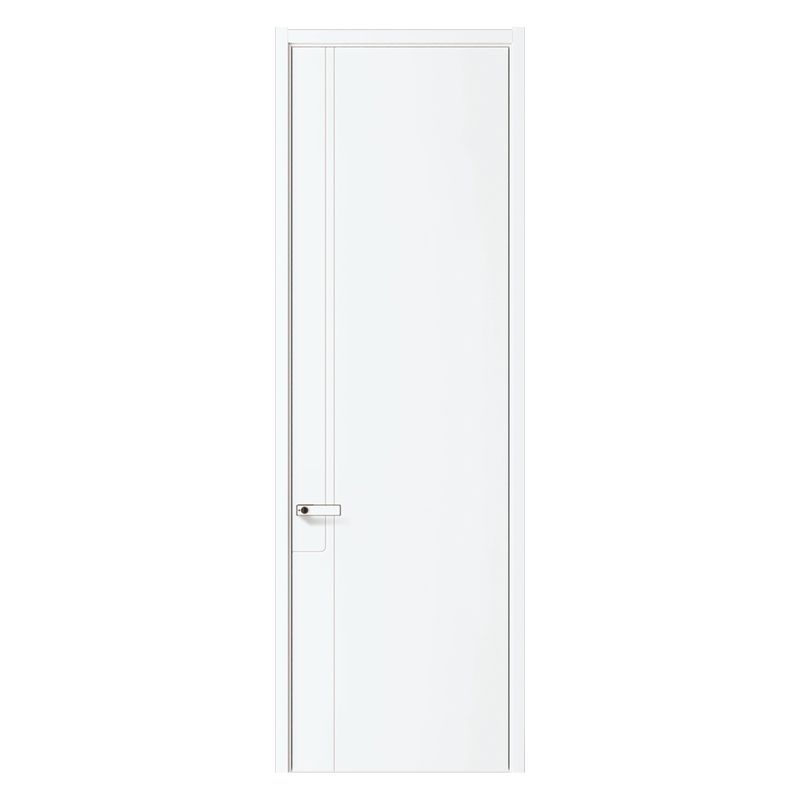
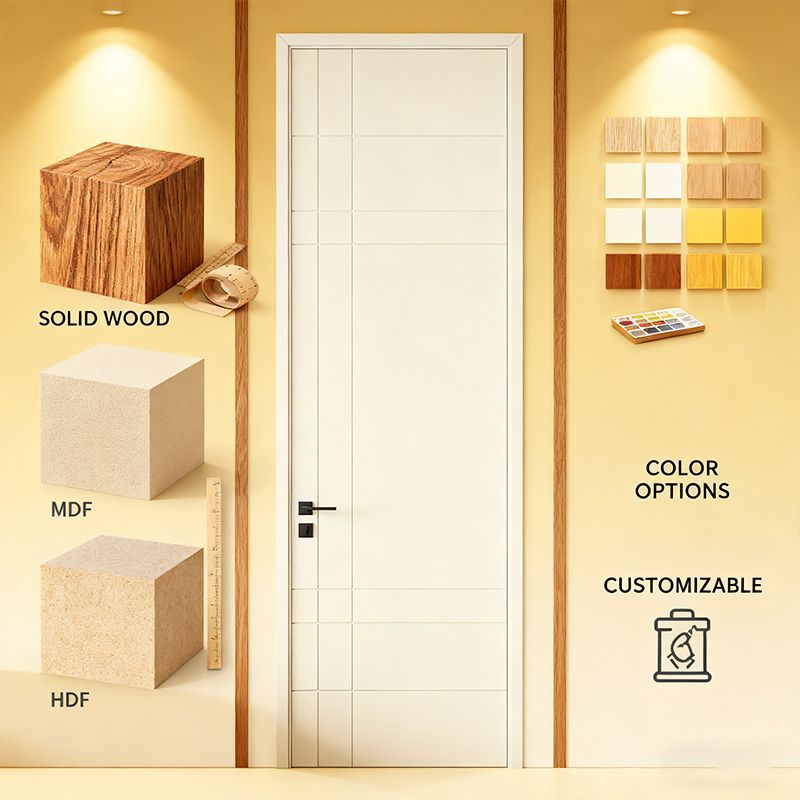
Homeowners choosing flat carving wooden interior doors often want the warmth of timber without the visual weight, dust traps, or space loss associated with ornate panel doors. Today’s modern flat carved interior doors combine a flush-door profile, wood veneer, and CNC relief carving to create clean lines for apartments, townhouses, and open-plan homes. The best flat carving wooden door manufacturer also controls moisture content, edge construction, and finish quality instead of treating the door as a decorative surface alone. For buyers comparing ROI HOME and other suppliers, the practical question is not simply whether a door looks attractive; it is whether the design will remain stable, easy to clean, quiet, and proportionate to the room.

Why Flat Carving Wooden Interior Doors Are Gaining Attention
The interior-door market is moving away from highly ornamented profiles toward surfaces that support minimalist, Japandi, contemporary, and transitional interiors. This shift is visible in renovation projects where buyers are replacing hollow-core doors, dated raised panels, and inconsistent room-by-room styles with a coordinated door system.
Several practical problems are driving the change:
- Limited floor area: A flat face creates less visual interruption in narrow corridors and compact apartments.
- Cleaning concerns: Shallow carved lines collect less dust than deep mouldings and complex applied ornament.
- Acoustic expectations: Bedrooms, studies, and nurseries need a better door leaf and perimeter seal than a lightweight hollow-core product can usually provide.
- Inconsistent materials: Buyers increasingly want the door, wardrobe, wall panel, and skirting to coordinate in color and grain.
- Long-term maintenance: A repairable veneer or painted timber surface is often easier to refresh than a damaged decorative laminate with a discontinued pattern.
The design opportunity is subtle texture. Instead of adding large mouldings, manufacturers machine linear grooves, geometric recesses, or low-relief motifs into a stable wood-based panel. The result is a door that reads as a solid architectural plane from a distance and reveals craftsmanship at close range.
Key Drivers Behind the Flat Carving Wooden Door Manufacturer Market
Space-efficient design for modern floor plans
Open-plan living areas, smaller urban bedrooms, and narrow circulation zones favor doors with a simple outline. A flush door with a consistent 40–50 mm visible stile-and-rail proportion, depending on the construction, can look less busy than a heavily profiled door. The actual benefit is visual rather than a guaranteed increase in floor area: the door occupies the same opening, but its uninterrupted face makes adjacent walls appear more continuous.
Demand for coordinated interior finishes
Many residential projects now specify one finish family across doors, cabinetry, wall panels, and storage. Natural oak, walnut, ash, smoked veneer, and warm painted colors remain popular because they can support both restrained and expressive schemes. A reliable supplier should provide a physical sample because screen colors cannot accurately show pore structure, gloss level, or the difference between crown-cut and quarter-cut veneer.
Improved manufacturing precision
CNC routing allows a manufacturer to repeat a groove pattern across multiple door leaves with controlled spacing and depth. This is especially useful for paired doors, tall doors, and projects with ten or more openings. Precision, however, does not remove the need for quality control. The supplier still needs to verify panel flatness, edge adhesion, veneer matching, sanding marks, and finish coverage after machining.
Health, emissions, and responsible sourcing expectations
Material documentation has become a purchase factor. The U.S. Environmental Protection Agency’s TSCA Title VI rule regulates formaldehyde emissions from composite wood products sold in or imported into the United States, with requirements covering products such as hardwood plywood, medium-density fiberboard, and particleboard. Buyers should request the applicable compliance documentation rather than relying on the phrase “eco-friendly.”
For responsible timber sourcing, the Forest Stewardship Council explains that FSC certification tracks controlled forest-related claims through a chain of custody. FSC certification does not automatically prove that every component of a complete door is certified, so the certificate scope and product claim should be checked on the quotation and packing documents.
Four Emerging Flat Carved Interior Door Trends
1. Low-relief geometric carving from a flat carving wooden door manufacturer
Thin vertical channels, offset rectangles, arches, and asymmetric lines are replacing deep decorative panels. Low-relief carving gives the surface a changing shadow pattern as daylight moves across it, while keeping the overall elevation calm.
This trend works particularly well when the groove depth is restrained and the pattern aligns with nearby architectural lines. A designer may continue a vertical motif from a door into a wardrobe or wall panel, but the alignment should be confirmed from a full-size elevation rather than inferred from a small sample.
2. Natural veneer with controlled visual variation
Natural veneer is being selected for its authentic grain, not because every door can look identical. Matching methods matter. Book matching mirrors adjacent veneer leaves; slip matching places them in the same direction; random matching accepts more variation. None is universally superior. Book matching can look formal, while random matching may suit a relaxed contemporary home.
Buyers should specify whether the quotation includes veneer direction, edge banding, repaired knots, sapwood tolerance, and color variation. A sample panel should show the actual stain or clear coat, because the same oak veneer can appear substantially different under a low-sheen waterborne finish and a darker pigmented stain.
3. Concealed frames and taller door proportions
Flush-jamb or concealed-frame systems support a wall-to-door appearance that is increasingly common in minimalist homes. Taller leaves can emphasize ceiling height, but the structure must be engineered for the finished weight. The specification should identify hinge quantity and load rating, frame anchoring, wall tolerance, clearance at the head, and whether the door is suitable for a concealed closer.
A tall door is not automatically a better door. If a leaf is unusually wide or heavy, ordinary hinges, weak fixing points, or an undersized frame can lead to sagging and rubbing. Ask for the maximum tested leaf size and weight instead of accepting a general statement that the system is “strong.”
4. Acoustic and soft-close upgrades
Flat carved doors are increasingly specified with perimeter seals, drop seals, magnetic latches, and solid or engineered cores. These features can reduce sound leakage and improve closing behavior, but the door’s acoustic performance depends on the complete assembly: leaf, frame, seals, threshold, wall construction, and installation.
For a bedroom or study, request a tested sound-reduction rating when a measurable target matters. A decorative door leaf without a sealed frame should not be marketed as a complete acoustic solution. Soft-close hardware can reduce slamming, but it does not replace accurate hinge installation or correct door clearances.
How Construction Affects Performance
Core selection
Common options include hollow core, honeycomb or tubular engineered cores, particleboard cores, laminated timber cores, and solid timber constructions. Lightweight cores can reduce hinge load and shipping weight, while denser cores generally offer a more substantial feel and can support better acoustic performance when combined with a sealed frame.
Ask the manufacturer to state the core material, density where relevant, door thickness, face material, and permitted trimming allowance. A door advertised as “solid wood” may contain engineered components, and engineered construction is not automatically inferior. In fact, carefully balanced engineered layers can reduce movement compared with a wide, unbalanced solid timber slab.
Moisture content and dimensional stability
Wood responds to indoor humidity. The USDA Forest Products Laboratory’s Wood Handbook: Wood as an Engineering Material explains that wood exchanges moisture with surrounding air and changes dimension as its moisture content changes. This is why a responsible factory conditions timber and verifies moisture content before assembly.
Do not use one moisture number as a universal guarantee for every climate. A door intended for a dry heated home, a humid coastal house, and an air-conditioned apartment may require different conditioning and installation guidance. The supplier should state the recommended indoor relative-humidity range, acclimatization procedure, and warranty exclusions for severe environmental changes.
Finish durability and repairability
Clear coats, pigmented lacquers, oils, and waterborne finishes produce different levels of gloss, tactile feel, and repairability. The relevant performance questions include:
- What abrasion or scratch testing was performed, if any?
- Is the finish suitable for frequent wiping with a diluted neutral cleaner?
- How are exposed edges and routed grooves sealed?
- Can a local scratch be repaired without refinishing the entire leaf?
- Does the warranty cover color variation between production batches?
For ordinary residential use, cleaning instructions should be simple: remove dust with a soft cloth, wipe spills promptly, avoid abrasive pads, and do not saturate the door or allow water to remain in carved recesses.
Flat Carving Wooden Interior Doors: Buyer Impact by Room
Bedrooms and children’s rooms
Prioritize reliable latching, smooth edges, controlled closing, and an appropriate acoustic assembly. A shallow pattern is easier to inspect for chips and easier to clean. If young children are present, confirm that the hardware does not create pinch hazards and that the door can be opened from the required side in an emergency.
Living rooms and dining areas
These rooms are where design consistency has the greatest visual effect. A pair of carved doors can frame a dining room or separate a living area without looking like a traditional formal partition. Check the pattern at the meeting stile: an attractive single-leaf design may look misaligned when mirrored on a pair unless the manufacturer prepares a dedicated pair layout.
Bathrooms and utility spaces
Humidity exposure requires more careful specification. Use a moisture-resistant core and fully sealed edges where appropriate, and maintain ventilation. A standard interior timber door should not be assumed suitable for direct water contact, steam rooms, or locations with repeated condensation.
Home offices and study rooms
These rooms benefit from a dense door leaf, compression seals, and accurate installation. If online meetings or recording are important, ask for an assembly-level acoustic test. A carved groove itself is not the main determinant of sound control; gaps around the leaf usually matter more.
How to Evaluate a Flat Carving Wooden Door Manufacturer
Before comparing prices, create a written schedule. It should include door quantity, opening size, wall thickness, handing, leaf thickness, core, veneer or paint system, carving drawing, hardware, frame type, seals, packaging, delivery terms, installation responsibility, and warranty period.
Request measurable samples
Ask for a corner sample or a full-size section showing the carved groove, edge, face finish, and frame connection. Inspect the surface under both daylight and warm artificial light. Run a clean cloth across the carving to identify rough fibers or sharp lacquer ridges. Compare the sample with the approved color under the lighting conditions used in the project.
Confirm tolerances and installation requirements
A high-quality door can perform poorly if the opening is out of plumb or the frame is installed without adequate fixing. Request the permitted wall-opening tolerance, recommended gap sizes, fixing method, and sequence for floor finishing. The installer should verify the finished floor level before setting the frame, especially for concealed-frame systems.
Review documents, not only showroom claims
Useful documents may include a product datasheet, finish-care guide, material declaration, formaldehyde or composite-wood compliance evidence where required, FSC certificate details if an FSC claim is made, fire-rating documents for regulated projects, and hardware load information. The exact documents depend on the destination country and building code.
Practical Specification Checklist for ROI HOME and Comparable Suppliers
- Define the design: provide elevation drawings with groove width, depth, spacing, corner radii, and pattern direction.
- Define the construction: state leaf thickness, core type, face veneer or paint, edge material, and allowable trimming.
- Define the environment: identify climate, expected indoor humidity, bathroom exposure, heating, and air-conditioning conditions.
- Define the hardware: list hinges, latches, seals, handles, closers, magnetic catches, and accessibility requirements.
- Define the finish: approve gloss level, stain tone, veneer matching, acceptable natural variation, and cleaning method.
- Define quality control: agree on inspection points for flatness, carving accuracy, finish defects, color consistency, packaging, and labeling.
- Define after-sales support: request replacement-part availability, touch-up guidance, warranty exclusions, and a process for reporting transit damage.
ROI HOME can be evaluated using the same criteria as any other supplier: the clarity of its technical specification, the consistency of its samples, the traceability of materials, the capacity to coordinate doors with wall panels or cabinetry, and the quality of pre-shipment inspection. A brand name should support the decision, not replace evidence.
Cost, Lead Time, and Project Risk
Custom carving typically adds cost through programming, tooling, sampling, machining, sanding, and finishing. The price difference is affected by the number of unique patterns, not only by the size of the door. Repeating one approved design across a project is generally easier to control than ordering a different motif for every opening.
Lead time should be divided into design approval, sample production, material procurement, manufacturing, finishing, inspection, packing, shipping, and installation. Ask for dates for each stage. A supplier that gives only one broad delivery promise makes it harder to identify where a delay has occurred.
To reduce risk, approve one production sample before releasing the full order, photograph packed goods, label every leaf and frame by room, and keep spare finish material or a touch-up kit. For large projects, reserve a small quantity of matching veneer or paint from the same batch when possible.
Common Mistakes to Avoid
- Choosing from a digital image alone: monitor settings hide grain, sheen, and color variation.
- Assuming “solid wood” means maximum stability: balanced engineered construction may move less than a wide solid slab in changing humidity.
- Specifying a tall door without hardware calculations: leaf weight, hinge rating, and frame fixing must be considered together.
- Ignoring the frame: gaps, seals, and frame alignment strongly influence closing, noise, and perceived quality.
- Using deep grooves in high-contact areas: shallow, sealed carving is usually more practical near handles, children’s rooms, and busy corridors.
- Making unsupported environmental claims: request the relevant certificate, test report, or compliance declaration.
- Leaving installation until the end: concealed frames, finished floors, skirting, and wall thickness must be coordinated before construction.
Final Outlook for Flat Carved Wooden Interior Doors
The strongest trend is not decoration for its own sake. It is controlled texture: a flush architectural surface with enough relief to create shadow, warmth, and identity. Buyers who compare core construction, moisture guidance, finish testing, hardware capacity, emissions documentation, and installation details will make a more reliable choice than buyers who compare photographs alone. Whether the project uses ROI HOME or another flat carving wooden door manufacturer, the best result comes from matching the carved pattern to the room, the construction to the climate, and the hardware to the actual leaf weight. That approach makes a flat carving wooden interior door a durable part of modern residential design rather than a short-lived visual trend.
Semantic terms covered: flat carving wooden interior doors, modern flat carved interior doors, flat carving wooden door manufacturer, flush doors, wood veneer, minimalist interiors, CNC relief carving, moisture content, FSC chain of custody.
Industry references consulted: U.S. Environmental Protection Agency, TSCA Title VI formaldehyde emission standards for composite wood products; Forest Stewardship Council, chain-of-custody certification principles; USDA Forest Products Laboratory, Wood Handbook: Wood as an Engineering Material, sections on wood moisture content and dimensional change. Requirements and test methods may vary by country, product category, and building code.